

Quito lies along the eastern slopes of the Pichincha volcano at an altitude of about 2,850 meters (9,350 ft). Founded by the Spanish in 1534 on the site of an earlier Inca settlement, Ecuador’s capital city is known for its UNESCO-listed city center. Join us as we explore the best areas to stay in Quito, the gateway to highland Ecuador.
Most of Quito’s tourist attractions are concentrated in the Centro Histórico, one of the largest preserved colonial districts in South America. Its grid includes major attractions, including the Cathedral, the churches of San Francisco and La Compañía de Jesús, the Museo de la Ciudad, Casa del Alabado Pre‑Columbian Museum, and the Basilica del Voto Nacional.
The city’s linear layout follows a long north–south corridor stretching along a narrow plateau. Outside the Old Town, neighborhoods such as La Mariscal, La Floresta, and the northern business districts offer nightlife, dining, and shopping. Additionally, the Mitad del Mundo complex marks the location traditionally associated with the Equator.
The main trolleybus and Ecovía corridors run along Avenida 10 de Agosto and Avenida 6 de Diciembre, while the Quito Metro links Quitumbe in the south with El Labrador in the north. In addition, the TelefériQo cable car climbs to Cruz Loma at about 4,000 meters (13,100 ft).
Whether you’re interested in historic landmarks, Andean scenery, or contemporary neighborhoods, this guide explores the best areas to stay in Quito, with practical details on attractions, transport, and recommended accommodations.
What’s the best area to stay in Quito?

Quito stretches over 40 km (25 mi) along a narrow plateau shaped by valleys and hills. As a result, neighborhoods are arranged lengthwise, with significant elevation differences. From a traveler’s perspective, the best neighborhoods in Quito include the Old Town and the newer developments to the north.
The best area to stay in Quito is the Old Town. Quito’s UNESCO-listed Centro Histórico is home to colonial-era buildings, plazas, and museums, all within a walkable street grid laid out in the 1500s. Additionally, the Old Town is well connected by public transport, including the Trolebús, Ecovía, Metro, and local buses, making it practical for sightseeing. Find accommodation in Centro Histórico.
Meanwhile, another excellent location in Quito is La Mariscal. Anchored by Plaza Foch, this northern extension of the center developed in the 20th century and is home to many restaurants, cafés, nightlife venues, and boutique hotels. Find accommodation in La Mariscal.
Finally, La Floresta, La Carolina, and Bellavista are modern, generally upscale, and safe areas to stay in Quito.
Keep reading to learn more about the best neighborhoods for tourists in Quito, Ecuador.
Best Neighborhoods for Tourists in Quito: A Quick Guide
Below, you’ll find a short summary of the best Quito neighborhoods depending on your travel style and what you plan to do. Keep reading below to learn more about these areas.
- Best district for sightseeing: Old Town
- Safest areas to stay in Quito: La Floresta | La Carolina
- Best district for nightlife: La Mariscal
- Best location for business travelers: La Carolina
Best Areas to Stay in Quito: Top 6 Neighborhoods
1. Old Town (Centro Histórico)
The best area to stay in Quito for sightseeing


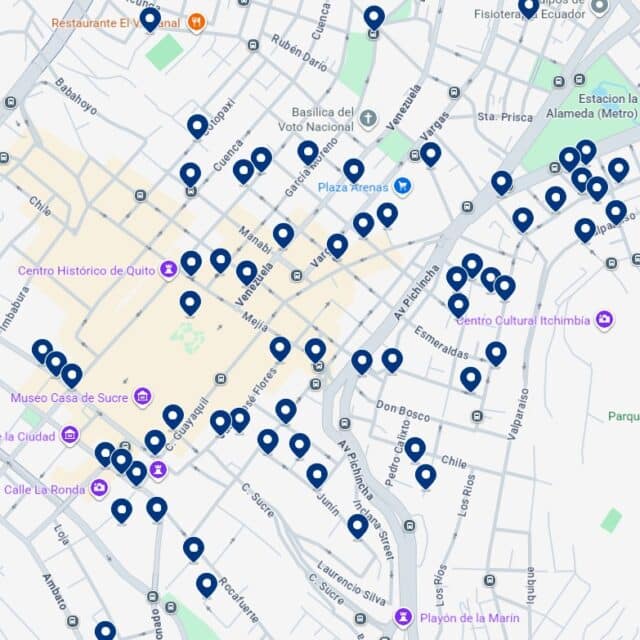
Famous for its colonial architecture, historic churches, and museums, the Old Town is an excellent place to stay in Quito.
Quito’s Old Town lies on the slopes of the Pichincha volcano, about 2,850 meters (9,350 ft) above sea level. A UNESCO World Heritage Site since 1978, it is considered one of the largest and best-preserved historical centers in the Americas.
Centro Histórico features colonial-era architecture, plazas, churches, and landmarks. The district is anchored by Plaza Grande, a historic square lined with important landmarks, including the Presidential Palace, the Cathedral, and the Archbishop’s Palace.
The Old Town is home to many historic churches and convents, such as the Iglesia de la Compañía de Jesús, completed in the 18th century and known for its gold-leaf interior decoration. Nearby, the Basilica and Convent of San Francisco, begun in 1535, is one of the oldest churches in South America.
Other attractions in Quito’s Old Town include the Museo de la Ciudad, which occupies a 1500s hospital complex and presents exhibitions on daily life in Quito across different centuries. Meanwhile, Museo de Arte Precolombino Casa del Alabado houses a vast collection of pre-Columbian art and archaeological objects.
El Panecillo, a 200-meter (656-feet) hill topped by the aluminum Virgin of Quito statue, offers viewpoints over the historic city center.
Daily activity concentrates along Calle García Moreno, Calle Chile, and Calle Guayaquil. However, nightlife in the Old Town is limited. Some cafés and bars open around Plaza San Francisco and La Ronda, a restored street with traditional houses.
Centro Histórico is very walkable and well-connected by public transport. Metro Line 1 stops at San Francisco and La Alameda, and the trolleybus (Trole) corridor runs along Avenida 10 de Agosto. Additionally, yellow taxis and ride‑hailing apps are widely available. Walking to La Mariscal takes about 25–30 minutes, depending on the route and altitude changes.
Accommodation in the Old Town ranges from budget hostels to boutique hotels and guesthouses in restored colonial buildings. Room rates in the Centro Histórico tend to be lower than in the northern districts, making it an excellent area to stay in Quito for backpackers.
Our Hand-Picked Accommodations in Quito’s Old Town (Centro Histórico)

Casona Tobar Hotel
Casona Tobar Hotel in Quito offers family rooms with private bathrooms, balconies, and views of the garden or the city. Each room includes a dining area, a work desk, and free WiFi.


2. La Mariscal
Recommended area to stay in Quito for nightlife


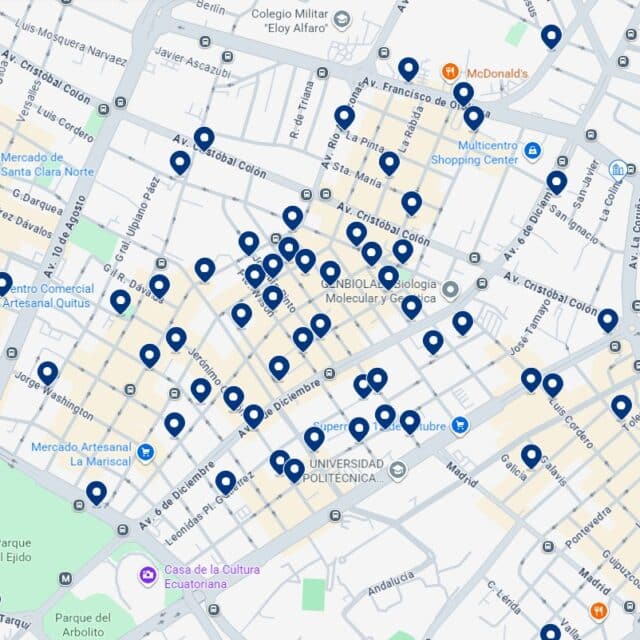
La Mariscal is an ideal base for exploring Quito’s nightlife, within walking distance of the city’s main attractions.
La Mariscal is located directly north of the Old Town and is known as Quito’s top dining and entertainment district. It features wide streets and a mix of Republican-era and mid‑century architecture.
Historically, La Mariscal developed as Quito expanded northward beyond its colonial grid. Soon, embassies, cultural clubs, and government offices were relocated to the district. By the late 20th century, its main streets had become busy commercial corridors.
La Mariscal is anchored by Plaza Foch, a pedestrianized square famous for hosting some of Quito’s most popular nightclubs, bars, and restaurants. Known locally as “La Zona,” the area around the plaza is home to bars, cocktail lounges, dance clubs, and small music venues that play rock, electronic, salsa, and reggaetón. Restaurants stay open late, especially on weekends, and many offer outdoor seating facing the square.
Beyond its nightlife, La Mariscal is also home to several cultural attractions. The National Museum of Ecuador displays pre-Columbian, colonial, and republican art. Additionally, Museo Mindalae presents Andean textiles, crafts, and traditional technologies, and Museo Manla focuses on Latin American naïf art.
Other sights in the district include Parque El Ejido, one of Quito’s largest central green spaces dating back to the early 20th century, and Mercado Artesanal La Mariscal, a covered market known for Andean textiles, ceramics, and hand‑woven crafts.
La Mariscal is generally flatter than Old Town, making walking easier. In addition, the neighborhood is well-connected by public transport. El Ejido station on Metro Line 1 is located on the district’s southern edge. Meanwhile, the Ecovía system offers stops at Baca Ortiz and Manuela Cañizares, both a short walk from Plaza Foch, and the trolleybus (Trole) passes along Av. 10 de Agosto. Taxis and ride‑hailing services are also easy to find.
Our Hand-Picked Accommodations in La Mariscal, Quito

Hotel Boutique Cultura Manor by Brater
Hotel Boutique Cultura Manor by Brater in Quito offers family rooms with balconies, private bathrooms, and views of the garden. Each room includes a spa bath, a walk-in shower, and free WiFi.

Hotel Boutique Vieja Cuba
Set in a modernist colonial mansion, Hotel Boutique Vieja Cuba offers accommodations in one of Quito’s finest commercial areas. It features massage facilities, free WiFi, and on-site private parking. Rooms at the hotel include cable TV channels and private bathrooms.

3. La Floresta
An upscale and safe area to stay in Quito


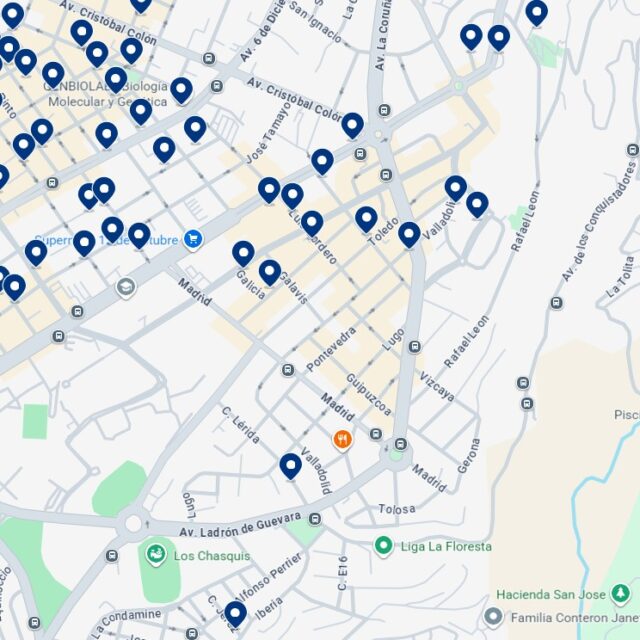
La Floresta is an artsy, residential, and safe district to stay in Quito.
La Floresta stretches east of La Mariscal toward the hills. Known for its residential streets and independent cultural scene, it is popular with expats and travelers seeking a local, bohemian vibe. La Floresta is also widely considered one of the safest neighborhoods in Quito.
Founded in 1917 as part of the “Garden City” initiative, La Floresta developed as an upscale residential district as the city expanded north. Its streets still reflect its original “Garden City” layout, with detached houses, small apartment blocks, and tree-lined slopes.
During the 1950s and 1960s, several local film studios and cultural groups settled in La Floresta, helping establish the area’s long connection to the arts. This identity strengthened over the following decades as cinemas, design workshops, and community spaces opened on the quieter streets.
Today, La Floresta is known for its independent cultural venues, like Ocho y Medio, one of the most recognized arthouse cinemas in Ecuador. It hosts festivals and screenings year‑round. In addition, small galleries, design shops, and artist studios occupy former houses along streets such as Madrid and Valladolid.
Daily life centers on small cafés, bakeries, and restaurants that line the main streets. In general, the area remains calm during the day. Compared with Plaza Foch, La Floresta’s nightlife tends to be more relaxed and spread out.
La Floresta is home to several important academic institutions, including the National Polytechnic School, the Pontifical Catholic University of Ecuador, and the Simón Bolívar Andean University, giving the area a strong student character. There are also a handful of small museums, including the Museo de Historia Natural Gustavo Orcés V. and Museo Plutarco Naranjo Vargas. In addition, the Coliseo General Rumiñahui hosts sports events and concerts.
Public transport in La Floresta includes Ecovía Baca Ortiz and 12 de Octubre stations on Avenida 6 de Diciembre. Taxis and ride‑sharing services are also available.
Our Hand-Picked Accommodations in La Floresta, Quito

Casa Aliso Hotel Boutique
Set in a charming house built in 1936, Casa Aliso Hotel Boutique offers rooms with free Wi-Fi and private balconies in the upscale La Floresta district. Rooms at Casa Aliso are fitted with heating and private bathrooms with complimentary toiletries.


4. La Carolina
Best location in Quito for business travelers & families


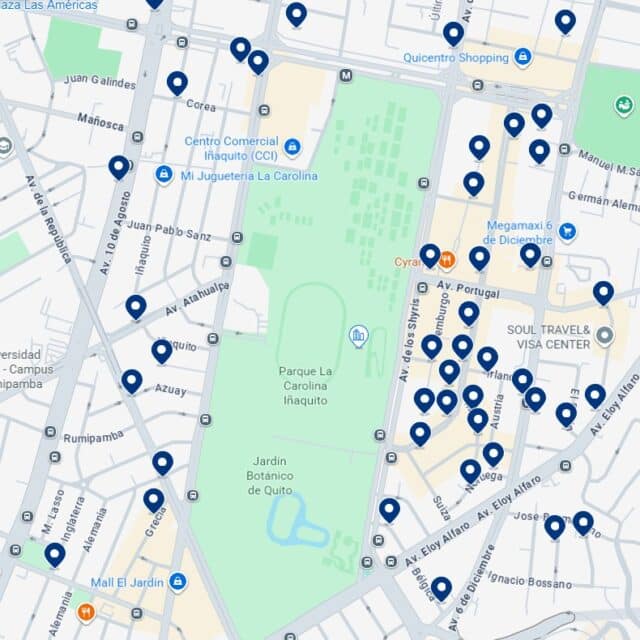
La Carolina is a modern district with high-rise hotels and shopping centers. Safe and family-friendly, it is one of the best areas to stay in Quito.
Located in north Quito, about 5 kilometers (3 mi) away from the Old Town, La Carolina is an upscale neighborhood known for its expansive park, modern high-rise towers, and large shopping centers. Today, it is considered Quito’s Central Business District.
The district’s main feature is Parque La Carolina, a 67‑hectare (165‑acre) urban park created in the 1940s on former agricultural land. It is home to running paths, sports courts, a skatepark, boating areas, and a dinosaur museum. Inside the park, the Quito Botanical Garden displays collections of different plant species, including Andean and Amazonian orchids and bonsais.
The park is flanked by three major avenues: Río Amazonas, Shyrys, and Naciones Unidas, home to the city’s major shopping and entertainment complexes, including Mall El Jardín, CCI (Centro Comercial Iñaquito), and Quicentro Shopping.
As to nightlife, you’ll find cocktail bars, cafés, after‑work spots, and restaurants along Avenida de los Shyris and República de El Salvador.
Transport links are straightforward and include the Carolina and Iñaquito Metro stations, as well as several Ecovía stops on Avenida 6 de Diciembre. Avenida Naciones Unidas and Avenida de los Shyris also have frequent bus services toward La Mariscal and northern Quito, and taxis are widely available.
Accommodation in La Carolina includes some of Quito’s top-rated luxury hotels, modern business properties, and serviced apartments. Many properties are located in high-rise towers and offer views of the park.
Our Hand-Picked Accommodations in La Carolina, Quito

Wyndham Garden Quito
Wyndham Garden Quito in Quito offers family rooms with private bathrooms, mountain or city views, and modern amenities. Each room includes a tea and coffee maker, a work desk, and free WiFi.

Hotel Republica
Featuring a restaurant, a bar, and free Wi-Fi, Hotel Republica is located in Quito’s La Carolina neighborhood. It offers rooms with plasma TVs, fans, safety deposit boxes, and work desks. All rooms also include free bottled water, and some feature a seating area.

Le Parc Hotel, Beyond Stars
This 5-star design hotel is located in Quito’s business and financial district. It offers free Wi-Fi, a gym, and luxurious rooms fitted with modern furnishings. Each room also has a flat-screen TV, a seating area, and a private bathroom with luxurious details and complimentary toiletries.
5. Bellavista
An excellent location for travelers to Quito


Hillside Bellavista offers impressive views in a quiet residential location surrounded by nature.
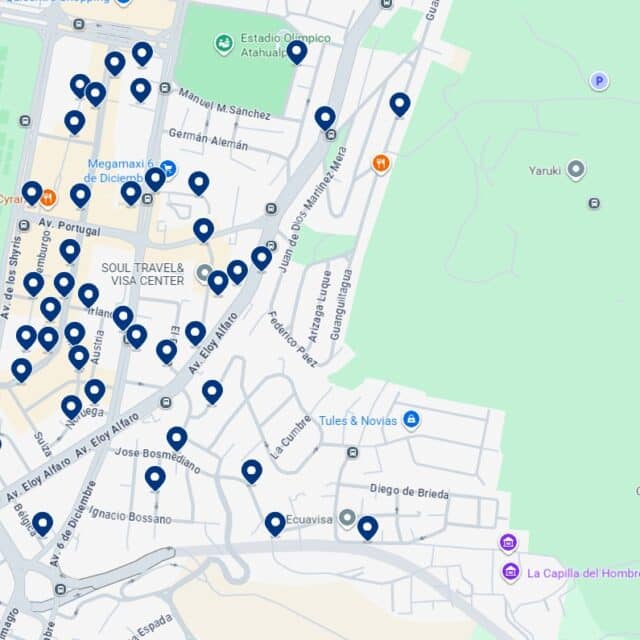
Situated on the hillside above La Carolina Park, Bellavista is a residential neighborhood known for its tranquil streets and hillside views. Developed as an upscale district during the city’s northern expansion. Today, it is considered one of the safest areas in Quito.
One of Bellavista’s main highlights is Parque Metropolitano Guangüiltagua. This expansive park spans over 550 hectares (1,360 acres) of forested hills, making it one of the largest urban parks in South America. It features miles of hiking and biking trails, picnic areas, and scenic viewpoints. The Metropolitan Park is also a popular birdwatching destination, home to many native Andean species, including hawks, hummingbirds, and woodpeckers.
Major cultural landmarks in Bellavista include the Guayasamín Museum and Capilla del Hombre, a massive art complex dedicated to Ecuadorian painter Oswaldo Guayasamín. The museum displays the artist’s works and personal collections, while the Capilla del Hombre, inaugurated in 2002, presents large-format pieces addressing Latin American history and social themes.
Bellavista is generally much calmer than La Mariscal or La Carolina. Most activity takes place along the avenues at the base of the hill, such as República de El Salvador and 6 de Diciembre, while the upper streets remain primarily residential. Dining options consist of cafés, small restaurants, and places geared toward residents.
Transport connections in Bellavista are more limited than in other districts and depend on elevation. While the lower part of the district is within walking distance of La Carolina’s Metro and Ecovía stops, there are few options as you move farther uphill. Taxis and ride-sharing services are frequently used for moving up or down the hillside.
Our Hand-Picked Accommodations in Bellavista, Quito

Hotel Bellavista Quito
Featuring a restaurant and a garden, Hotel Bellavista Quito offers accommodations with free WiFi. Rooms are equipped with a flat-screen TV, a work desk, and a private bathroom with free toiletries. Free private parking is also available on site.


6. Guápulo
A Charming location to stay in Quito

Guápulo is ideal for travelers seeking a quiet atmosphere, colonial charm, and scenic views.
Known as one of Quito’s bohemian neighborhoods, Guápulo is located east of La Mariscal and directly south of Bellavista. It was founded in the 16th century as an independent settlement and features colonial architecture, cobblestone streets, artisan shops, and cozy cafés.
The area’s centerpiece is the Santuario de Guápulo, a historic colonial-era church located in a steep valley. While the church’s origins date back to the 1500s, the current building was completed in the 17th century, and contains altarpieces and paintings by the Quito School.
Guápulo is marked by its dramatic geography. Streets drop sharply from Avenida González Suárez toward the church, with viewpoints overlooking the valley and the eastern outskirts of Quito.
The area is also home to Parque Guápulo, a sprawling park with two lagoons and hiking trails among groves of palm and eucalyptus trees.
Today, Guápulo is home to a mix of long-term residents, artists, and small businesses. A few workshops and galleries operate in restored houses, and several cafés open onto terraces with views of the valley.
Transport options are limited due to the terrain. Buses run along Avenida González Suárez, the main road on the upper ridge. From there, entrances lead down into Guápulo on foot. Taxis and ride-sharing services can reach the lower streets, but circulation is slower on the narrow curves.
Our Hand-Picked Accommodations in Guápulo, Quito

Hotel Stubel Suites & Cafe
Hotel Stubel Suites in Quito offers stunning views of the Guápulo valley. Hotel facilities include a gym, a spa, a restaurant, and free Wi-Fi. Rooms at the hotel feature lush carpeting, LCD and cable TV, and a work desk. Some also have a kitchen, private balcony, and spa bath.
Read this in other languages:
